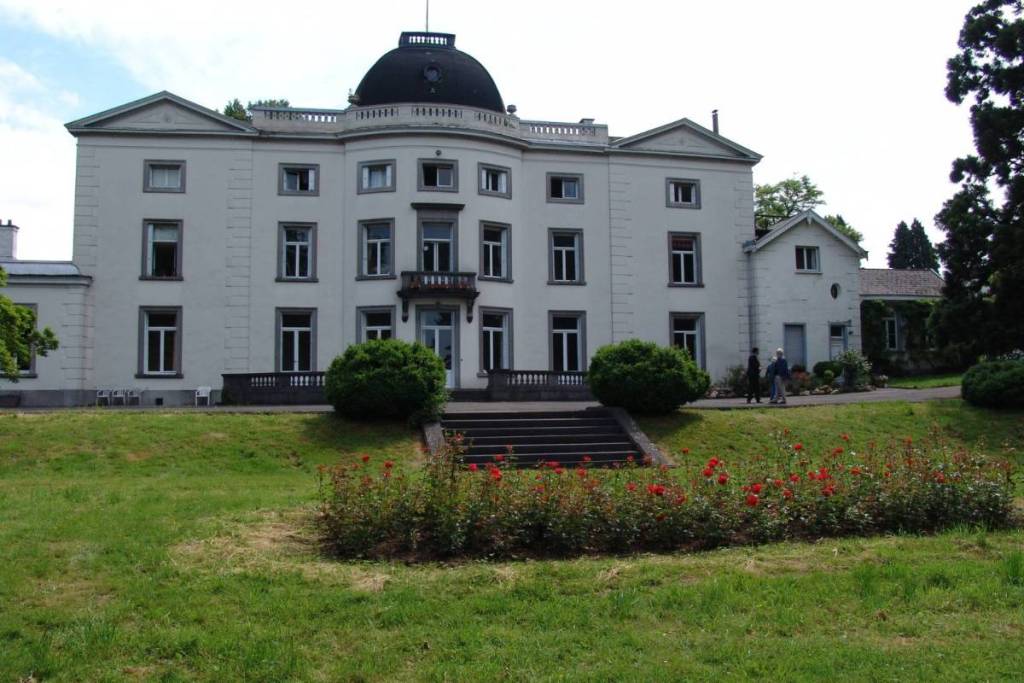

Nestled in Woluwe-Saint-Pierre, the Manoir d’Anjou is an exceptional estate with a fascinating history. Built in the late 19th century, this elegant neoclassical building became a refuge in exile for pretenders to the French throne. Behind its impressive facade crowned by a dome, the mansion preserves the glorious memory of its royal past, enhanced by an English-style park rich in rare botanical species. Now transformed into a peaceful haven for community and social activities, the estate combines aristocratic heritage with environmental initiatives. Let us tell you the fabulous story of this Brussels gem.
From Putdael Castle to the Manoir d’Anjou: the story of a palace in exile
In the early 19th century, the site that is now home to the Manoir d’Anjou was nothing more than a wooded plot of land that was once part of the Forest of Soignes. It was in 1885 that the property began to flourish under the leadership ofAlfred-Casimir Madoux. He had the Château de Putdael built there, a grand neoclassical country estate rising three stories high and crowned by a majestic central dome. Surrounded by outbuildings and ornamental statues, the building quickly established itself as a luxury residence in the southeastern part of the capital.
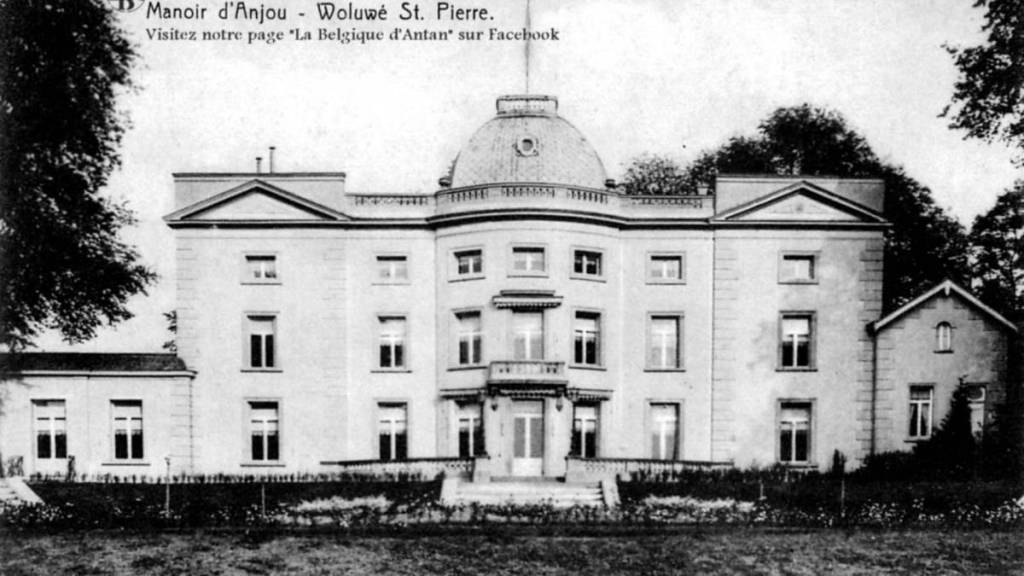
The estate’s fate took a turn in 1913 when Madoux’s widow leased and then sold the 12-hectare property to Philippe VIII, Duke of Orléans and pretender to the French throne. Subject to the law of exile, which prohibited him from residing on French soil, the prince found a haven of peace in Woluwe-Saint-Pierre, close to his relative, King Albert I. He renamed the site “Manoir d’Anjou ” and transformed the residence into a veritable princely palace, adorning the interiors with royal coats of arms and fleurs-de-lis.
Princely Remnants and an English-Style Park: The Preserved Treasures of the Estate
After the dark days of World War II, the estate was purchased in 1948 by the Sisters of the Good Shepherd, marking the end of its princely chapter. Despite this transformation, the Manoir d’Anjou still preserves precious reminders of its royal past. In the refectory stands an imposing fireplace engraved with the famous motto “Montjoie-Saint-Denis” and adorned with the coat of arms of the House of France, while fleurs-de-lis and heraldic details remain throughout the building.
Outside, the 5-hectare park features a splendid English-style landscape. A large lawn opens up to a view of a pond adorned with a rock grotto and an island connected by a rustic bridge. Now designated a Natura 2000 site, the grounds are home to rare plant species such as a ginkgo biloba, a Japanese cryptomeria, and a Virginia tulip tree. The former royal retreat has been transformed into a social and ecological haven, housing the Ferme d’Anjou and the Artos center, which serves people with disabilities.