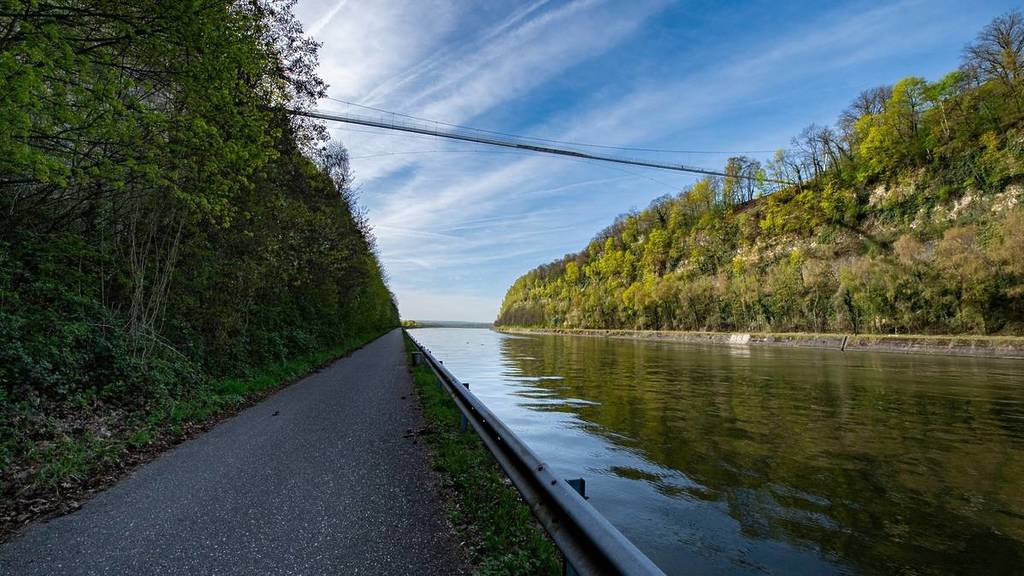

Towering 50 meters above the Albert Canal, the new Caster footbridge stands as an architectural feat in the heart of the Benelux. This 195-meter-long suspension bridge defies the laws of gravity thanks to its unique design and reestablishes a historic link between Wallonia, Flanders, and the Netherlands. Between the technical audacity of its construction and an immersive experience offering 360-degree panoramic views of the Geer & Meuse Border Park, discover how this metal icon transforms your visit into a spectacular journey through untamed nature and local heritage.
The Caster Footbridge: an architectural feat suspended 50 meters above the ground
The result of a “Design and Build” process, the Caster Footbridge stands as a testament to modern engineering. Designed by the firm Servais et Partners, this 195-meter-long structure features a unique aesthetic, supported by a single cable connecting two pylons of different heights: 17 meters on the left bank and 10 meters on the right bank. At the center of the structure, the deck widens over a 25-meter section, offering pedestrians a space for contemplation suspended 50 meters above the Albert Canal.
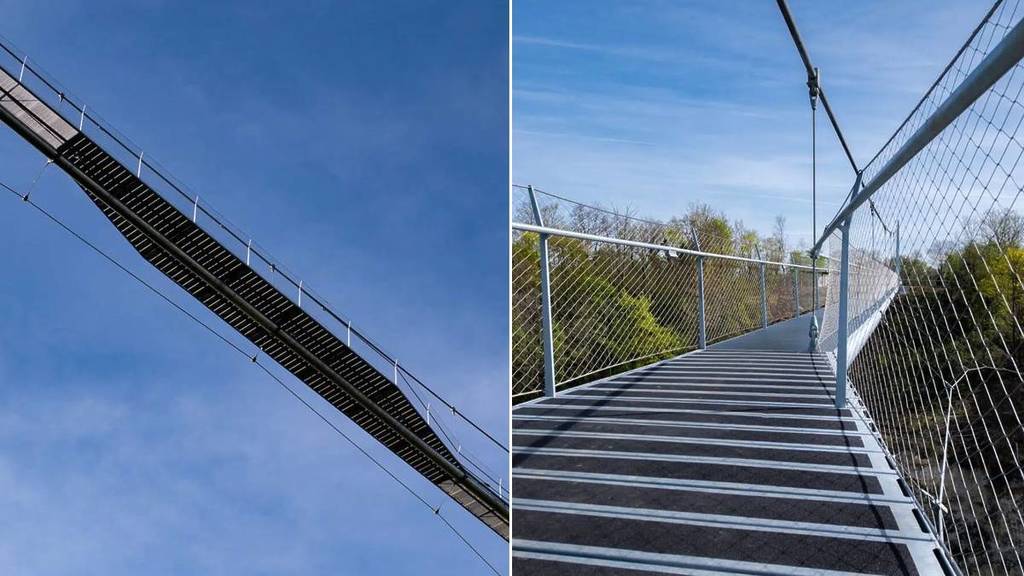
The construction of this steel giant celebrates local craftsmanship, as its modules were prefabricated in Jupille-sur-Meuse. The project faced extraordinary challenges: anchoring the pylons in chalk, deploying the main cable via a drone, and then assembling the sixteen modules as they slid over the void. This precision-engineered process allowed this unique structure to be tensioned before the installation of access points and safety gates. Now ready to welcome visitors, this technical feat offers a total immersion between sky and cliffs.
Disconnect and 360-degree panoramas: a bridge between three nations
Beyond the engineering, the Caster Footbridge offers a true escape. Suspended between the sky and limestone cliffs, visitors enjoy a 360-degree panorama of the valleys of the Geer & Meuse Border Park, inviting them to live in the moment. This toll bridge (€3) is more than just a crossing: it is an act of support for biodiversity, as the proceeds are directly reinvested in the preservation of the surrounding landscapes. Reserved for pedestrians, the site guarantees absolute tranquility, far fromthe hustle and bustle of the city.
Historically, this structure reestablishesthe former military route connecting Liège to Maastricht, severed in the 1930s by the digging of the Albert Canal. More than just infrastructure, the footbridge today symbolizes an unprecedented cooperation between Wallonia, Flanders, and the Netherlands. By connecting the towns of Visé, Bassenge, and Oupeye, it revitalizes the region through four new hiking trails. The Caster Footbridge thus serves as a link between the heritage of Fort Eben-Emael and the wilderness of Mount Saint-Pierre.
📍Rue du Fort, 4690 Bassenge, Belgium