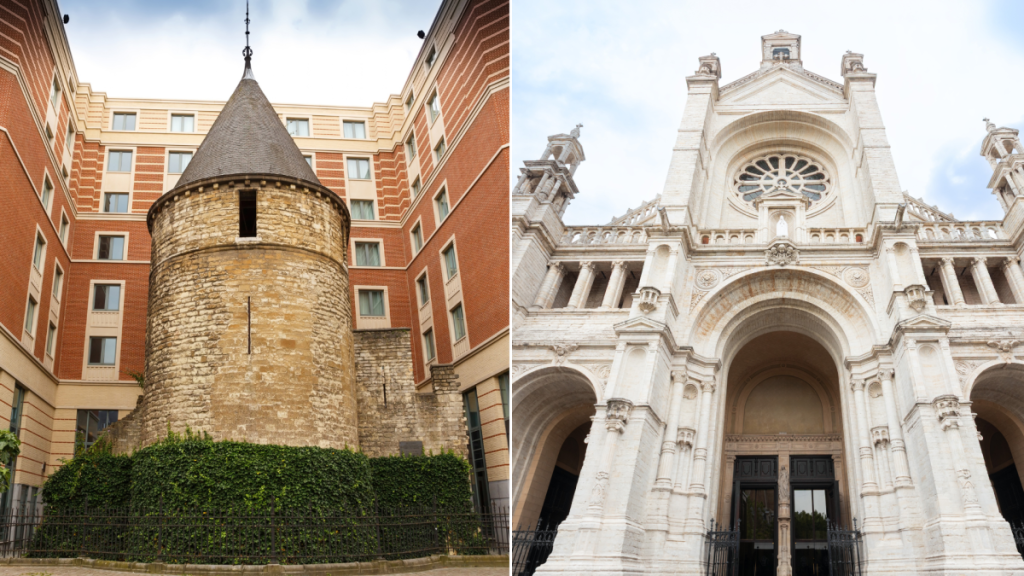

Nestled behindSt. Catherine’s Church, the Black Tower rises in the heart of Brussels as a striking anachronism amid contemporary facades. An enduring testament to the Middle Ages, this architectural gem is one of the best-preserved remnants of the first medieval city wall from the 13th century. Saved from demolition in the 19th century thanks to the passion of heritage advocates, this former military fortification alone tells the story of Brussels’ transformation. From its incredible survival through the ages to the secrets of its structure, immerse yourself in the unique history and architecture of this iconic monument of the capital.
From the 13th Century to the Present Day: The Incredible Journey of the Black Tower
Built in the early 13th century, the Black Tower served as a strategic bastion of Brussels’s first fortified wall—a four-kilometer rampart protecting the heart of the medieval city. After losing its military function in the 14th century with the construction of a second wall, the tower underwent a remarkable transformation. Converted into a residence following the development of the Sainte-Catherine harbor basins, the building survived the centuries and urban development projects to become a popular inn known as “In den Toren.”
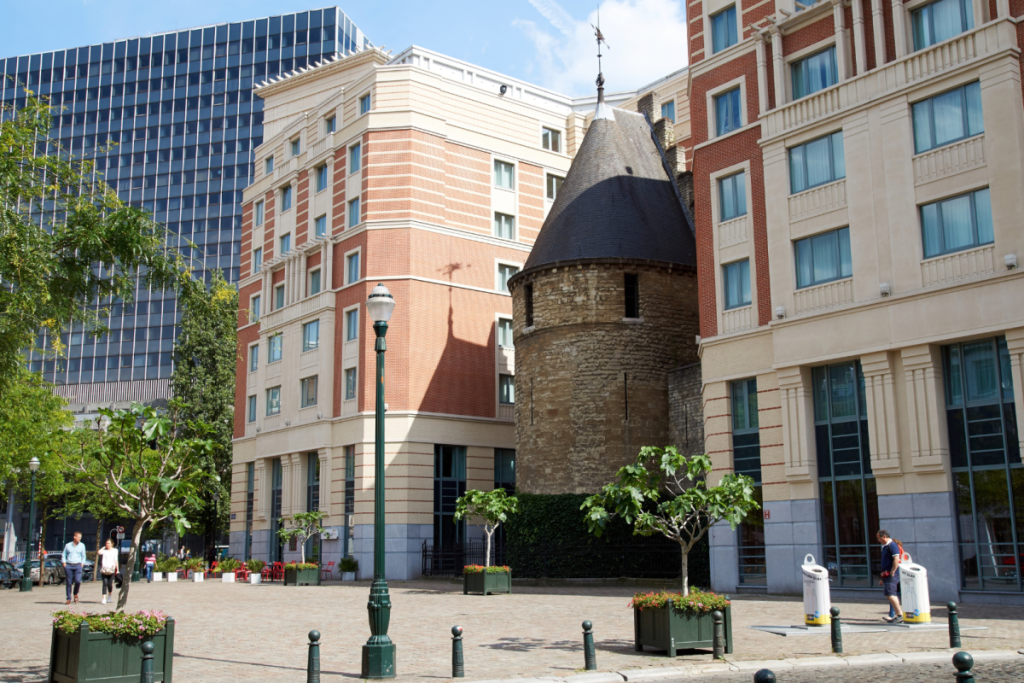
Its fate took a turn at the end of the 19th century: threatened with demolition during urban renewal work in the neighborhood, it was saved at the last minute in 1888 by Mayor Charles Buls, a passionate advocate for Brussels’ heritage. Architect Victor Jamaer orchestrated a meticulous restoration, reconstructing its stepped gable, conical roof, and arrowslits. In doing so, he restored the Black Tower to its iconic medieval appearance, ensuring its preservation at the heart of the contemporary urban landscape.
Unique architecture, blending military might with Gothic charm
With its semicircular shape, the Black Tower is distinguished by its Lédien sandstone facing, a local limestone restored in the 19th century. Bordered by an ancient moat, the structure reveals a remarkable duality of aesthetics and defense. Its façade rises beneath a five-tiered gable crowned by a pinnacle, featuring two large arched windows and equipped with a hoisting system. From the outside, the building asserts its military role with its narrow arrowslits, embrasures, and conical roof, topped by a weather vane.
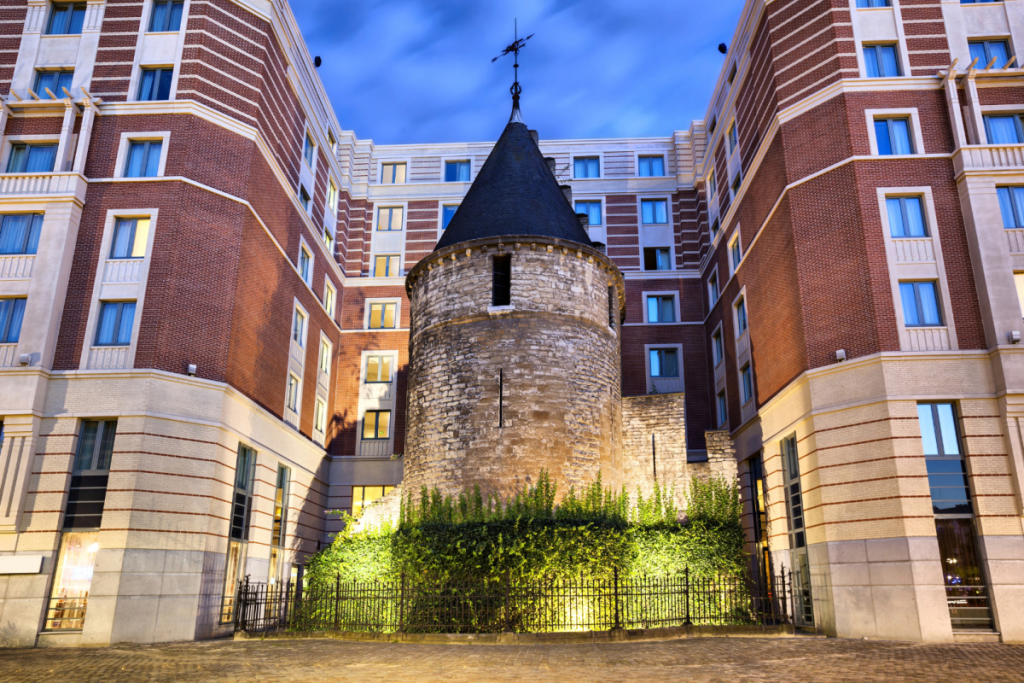
The interior of the tower reveals structural ingenuity suited to both defense and habitation. The lower level features a vaulted ceiling, as well as a passage leading to the parapet walk and a staircase concealed within the thickness of the wall. On the upper level, the thickness of the wall decreases dramatically on the town side, a design resulting from its conversion into a residence in the 16th century. The adjacent sections of the curtain wall, with their remnants of arches and embrasures, complete this precious fortified complex, a true centuries-old testament to local history.