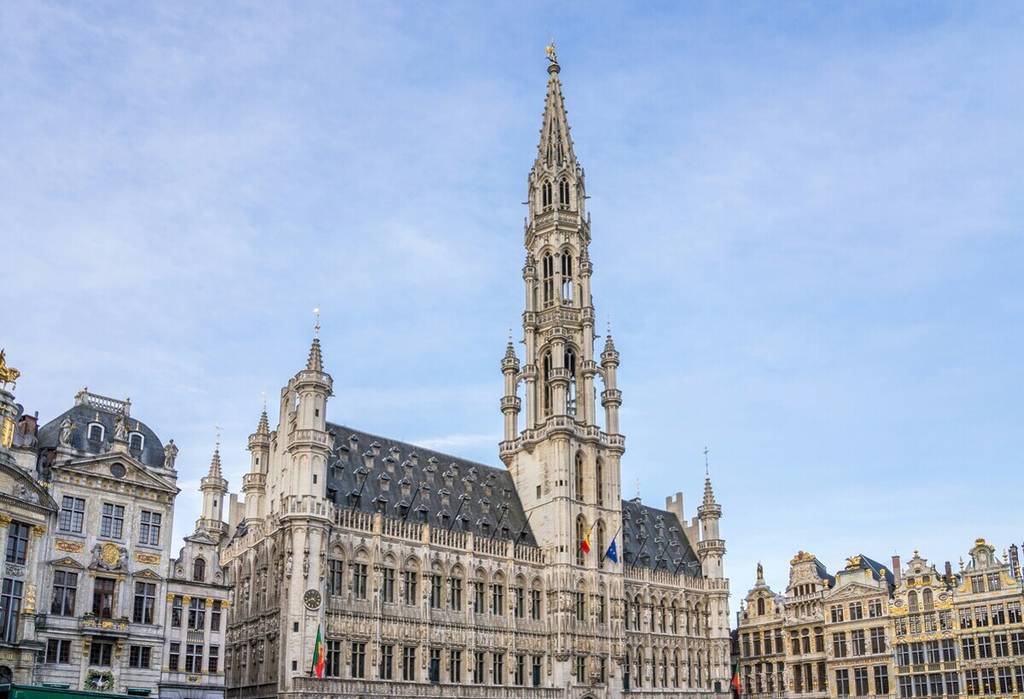
Dominating the most beautiful square in Europe,Brussels’ Hôtel de Ville is much more than just an administrative building. It is an absolute masterpiece of Brabant Gothic architecture, a monument to six centuries of history, power and resilience. A UNESCO World Heritage Site, it is the beating and symbolic heart of the Belgian capital.
This architectural treasure exceptionally opens its doors to host cultural events, transforming its historic halls into magical stages for experiences such as the Candlelight concerts.
Table Of Contents
- Construction of Brussels City Hall
- Who shaped this monument?
- Why is the Hôtel de Ville so inspiring?
- What can you do in this monument?
- Where is this Gothic jewel located and how do I get there?
- Is it possible to visit the interior of the Hôtel de Ville?
- Town Hall, the heart of Winter Fun
- Why isn't the tower in the middle of the Town Hall?
- Why does the Hôtel de Ville light up with flowers?
Construction of Brussels City Hall
Construction of the Hôtel de Ville took place over several decades, marking the height of Brussels’ communal power in the Middle Ages. The foundation stone for the left (east) wing was laid in spring 1402. Completion of the right (west) wing, and above all the famous tower, culminated in 1449.
The prestige of Brussels City Hall is universally recognized for its architecture, a model of Brabant Gothic, and for its resilience: it is the only medieval vestige still standing on the Grand-Place after the Bombardment of 1695. It is a symbol of Brussels’ strength and identity, a witness to history and official ceremonies.
Who shaped this monument?
Unlike many buildings, the Hôtel de Ville is the work of several architects, who succeeded one another in the course of construction and reconstruction campaigns. The first phase of the building (early 15th century) involved master builders such as Jean Bornoy and Jacques van Thienen for the East Wing and the beginning of the Tower.
The jewel in the crown, the openwork spire, was designed by Jean van Ruysbroeck (completed in 1455). It was he who gave the Tower its height and unique silhouette, surmounted by the Archangel Saint-Michel. After the bombardment of 1695, the south wing was rebuilt in the classical style by Corneille Van Nerven in the early 18th century.
Why is the Hôtel de Ville so inspiring?
The Hôtel de Ville has inspired some of the world’s greatest names, starting with Victor Hugo, who likened it to “a poet’s dazzling fantasy that fell from an architect’s head” . Its singularity lies in its vertiginous openwork spire, 96 metres high, crowned by the gilded statue of Saint Michael slaying the dragon.
The interior is just as spectacular as the exterior. The building conceals absolute splendor in its ceremonial rooms, adorned with historic tapestries, major objets d’art and sculpted decor. The first floor features a monumental staircase, while upstairs, the Salle Gothique is the setting for the grandest of receptions.
What can you do in this monument?
The Hôtel de Ville no longer houses the town’s administration, but it remains a lively venue for the town’s most prestigious events. It is still the setting for major ceremonial events, such as swearing-in ceremonies and receptions for foreign heads of state.
The Grand-Place’s impact on contemporary culture is also strong: after giving a spectacular concert on the square itself, members of the cult group Indochine had the privilege of visiting the Hôtel de Ville, thus following in the footsteps of the sovereigns. The Hôtel de Ville is also the venue for exceptional cultural events, such as the famous Candlelight concerts.
Where is this Gothic jewel located and how do I get there?
Brussels City Hall is located in the heart of the city, on the Grand-Place itself. It faces the King’s House. It’s the capital’s historical and tourist epicenter. Getting there couldn’t be easier: the Central Station is just a few minutes’ walk away. It’s the ideal stop, as it serves the metro lines (1 and 5) and trains.
You can also opt for the Bourse stop, which is well served by streetcar and bus. Please note that the Grand-Place is pedestrianized: if you’re coming by car, use the nearby underground pay parking lots, such as Parking Grand-Place or Parking Bourse.
Is it possible to visit the interior of the Hôtel de Ville?
Yes, you can visit the Hôtel de Ville. Guided tours are organized on a regular basis, taking visitors through the historic rooms, tapestries and monumental staircase, enabling them to look back over six hundred years of history. For the more adventurous, it’s even possible to climb the tower for an exceptional view.
Town Hall, the heart of Winter Fun
Every winter, the Grand-Place, dominated by the majestic architecture of the Hôtel de Ville, becomes the focal point of Plaisirs d’Hiver, Brussels’ famous Christmas Market. Although the event extends throughout the city center, it’s at the foot of the Gothic monument that the impressive Christmas tree stands and the spectacular sound and light shows are projected.
Why isn’t the tower in the middle of the Town Hall?
The asymmetry of the Hôtel de Ville facade is famous and unique. This peculiarity is explained by the fact that the XVᵉ century building was designed and built in two distinct parts by different architects, who had to adapt the construction over time. The majestic spire is therefore naturally off-center in relation to the Gothic wings.
Why does the Hôtel de Ville light up with flowers?
The Town Hall hosts two exceptional floral events in Brussels. The first is the famous Tapis de Fleurs. Every two years, the Grand-Place is covered with hundreds of thousands of flowers, transforming the Gothic facade into the backdrop for an unforgettable show of color.
Alternately, it also hosts the Flowertime event. Over 100,000 flowers redecorate the sumptuous historic halls. These flower shows allow visitors to discover the Hôtel de Ville from a spectacular angle, blending Gothic art with the ephemeral beauty of nature.
Other prestigious venues in Brussels
Once you’ve explored the Gothic history ofBrussels’ Hôtel de Ville, extend your quest for the European capital’s secrets. Just across the street, on the Grand-Place, you’ll find the Maison du Roi (home to the Musée de la Ville de Bruxelles) and the magnificent Galeries Royales Saint-Hubert (just a few minutes’ walk away).
The Théâtre du Vaudeville and Steigenberger Wiltcher’s (on Avenue Louise) are other prestigious Brussels addresses which, like the Hôtel de Ville, host Candlelight concerts. These sublime venues are transformed into magical stages, where the soft glow of candlelight sublimates the architecture of Brussels!