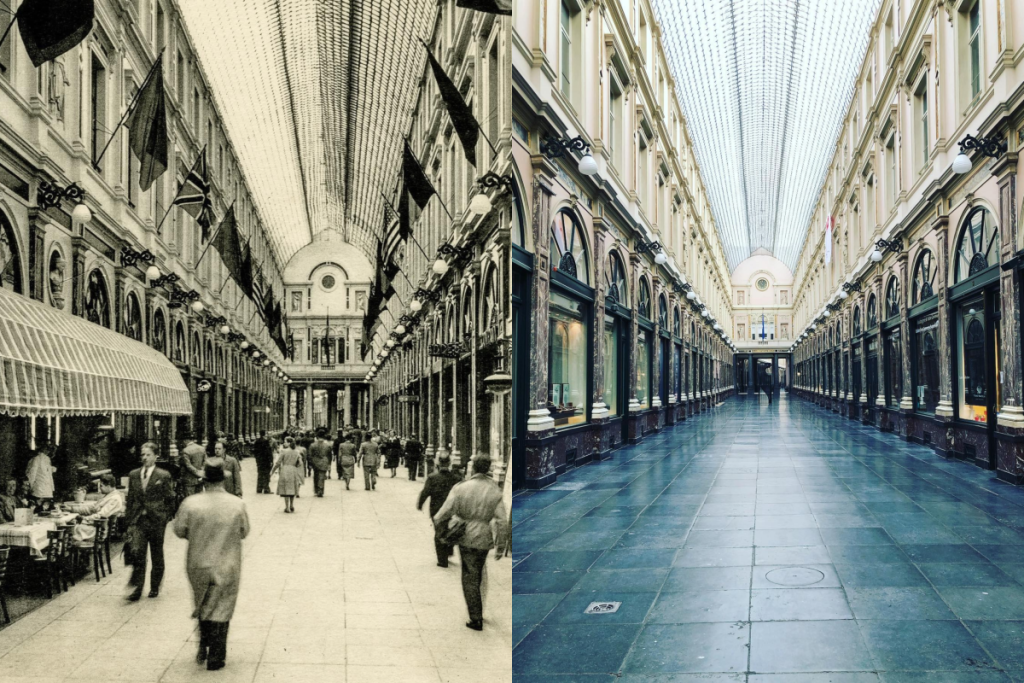

Inaugurated in 1847 by King Leopold I, this majestic passage transformed the heart of Brussels by establishing itself as Europe’s very first monumental gallery of the 19th century. Nicknamed the “Brussels Umbrella” because of its impressive glass roof, this masterpiece of the Florentine Renaissance has stood the test of time, becoming a haven for the greatest artists and intellectuals, from Victor Hugo to the Surrealists. Today, this listed monument elegantly combines its legendary cultural heritage with contemporary pleasures: exceptional chocolate shops, historic theaters, luxury boutiques, and dramatic lighting create an unparalleled experience.
The Birth of a European Architectural Masterpiece
Initiated in 1837 by architect Jean-Pierre Cluysenaer to revitalize a working-class neighborhood, the Galeries Royales Saint-Hubert project took shape with an official inauguration on June 20, 1847, in the presence of King Leopold I. By connecting the upper and lower parts of Brussels, the capital was ahead of major metropolises such as Milan and Berlin. Nicknamed the “Brussels Umbrella,” this masterpiece of Florentine Renaissance style broke new ground with its self-supporting glass roof featuring fish-scale panes, providing light, ventilation, and protection from the rain.
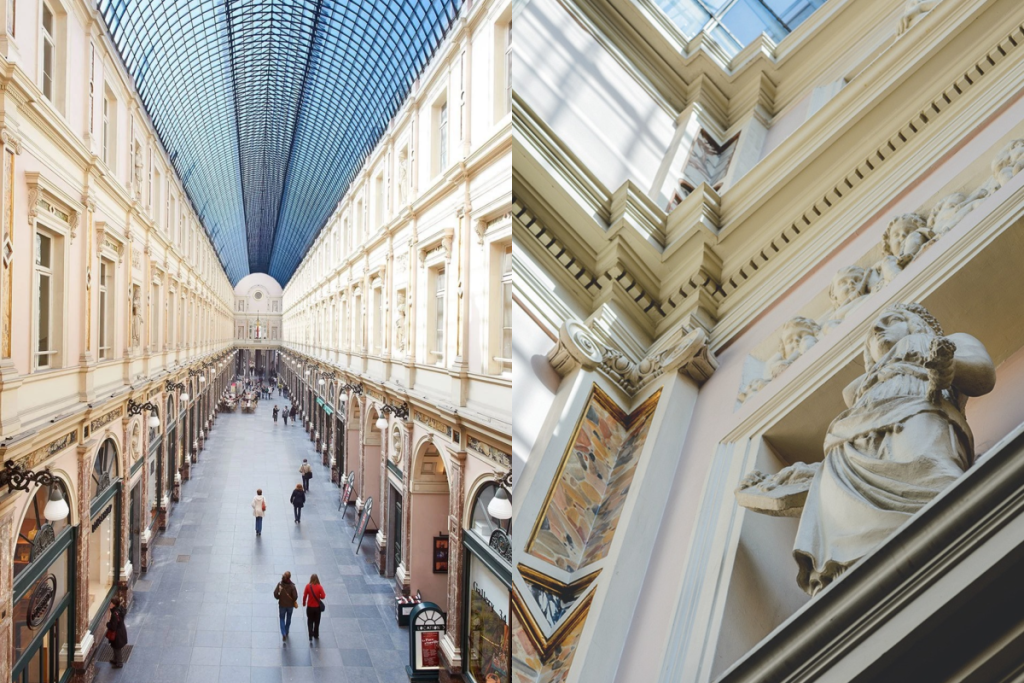
Organized into three sections—King, Queen, and Princes—this complex, home to shops, residences, and theaters, quickly became the beating heart of Brussels’ intellectual life. Illustrious artists crossed paths there: Victor Hugo, Alexandre Dumas, and French refugees established their headquarters there, followed later by the Surrealists. A place of major breakthroughs, the Galeries also hosted Belgium’s very first screening of the Lumière brothers’ cinematograph on March 1, 1896.
6 million visitors a year: the timeless success of the Galeries Royales Saint-Hubert
Now designated as a historic monument, the Galeries Royales Saint-Hubert have preserved the spirit of urban diversity while adapting their setting to modern demands. Once lit by delicate gas chandeliers, the arcades now feature dramatic LED lighting that enhances the architecture and regularly hosts sound-and-light shows. This enduring link between tradition and modernity is also evident in its cultural landmarks, such as the Théâtre Royal des Galeries (whose ceiling was redesigned by René Magritte) and the legendary Cinéma des Galeries.
Attracting nearly six million visitors each year just a stone’s throw from the Grand-Place, the passage has become a must-see destination in the capital. With stunning display windows from leading chocolatiers, watchmakers, and luxury jewelers, traditional brasseries, and the opening of the Hôtel des Galeries, the landmark offers a gourmet and elegant retreat sheltered from the elements. Still managed by the descendants of its founders, this Brussels gem continues to bring the heart of the city to life.